
Insight
What happens at a Fire and Police Commission hearing in Illinois?
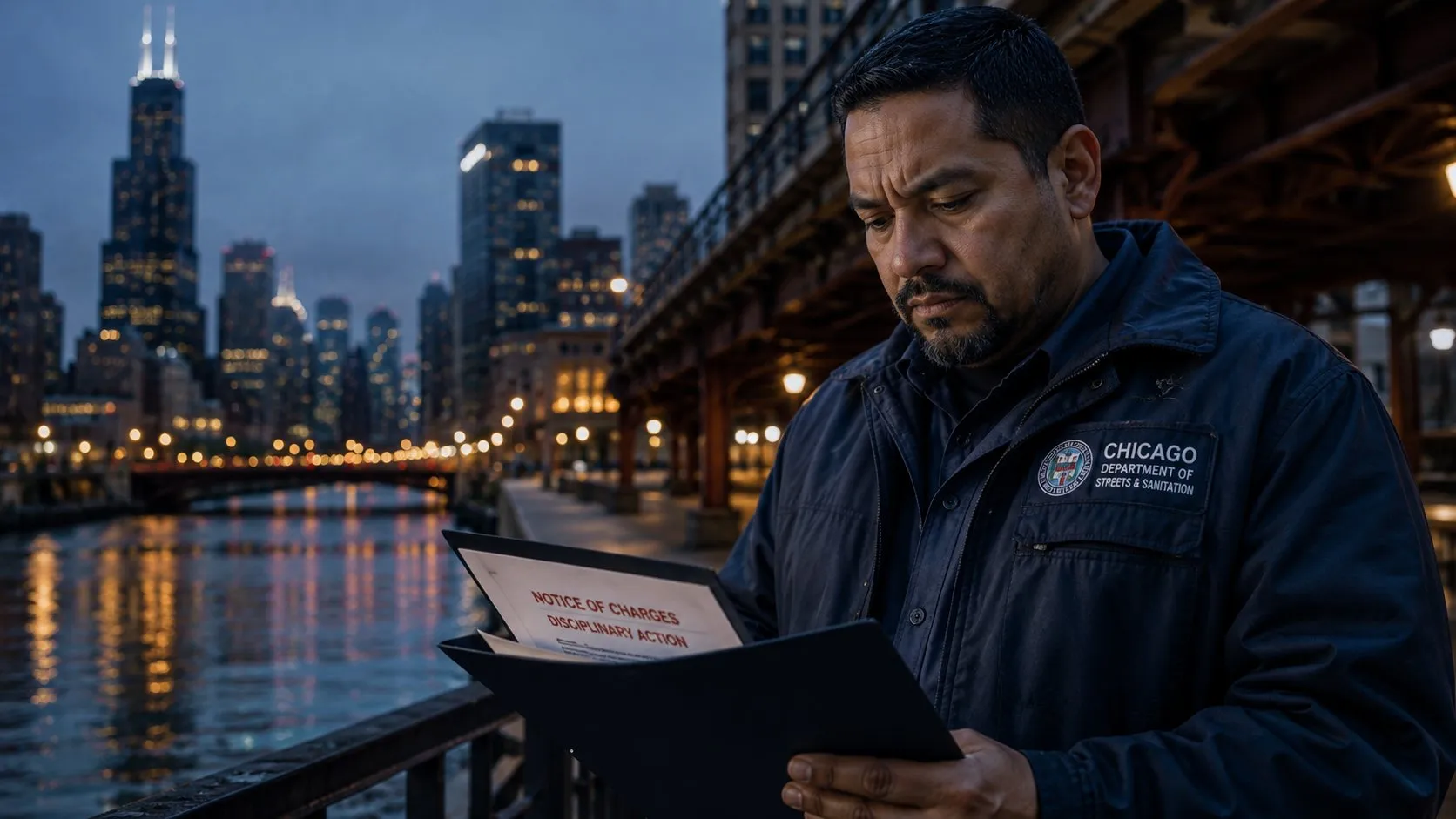
Short answer: The department files written charges, and a three-member Board of Fire and Police Commissioners holds a hearing that must start within 30 days. The department has to prove cause. You can present witnesses and subpoena records. The board can dismiss the charges, suspend you up to 30 days, or fire you. Court review must be filed within 35 days.
Who has a Board of Fire and Police Commissioners?
Most suburbs and mid-sized cities do. Under 65 ILCS 5/10-2.1-1, every municipality with a population between 5,000 and 250,000 that isn't run under the civil service division of the Municipal Code must appoint one. Towns under 5,000 can opt in. The mayor or village president appoints three commissioners to three-year terms, with council or trustee consent.
A few towns in that range run police and fire under the civil service division instead, where a civil service commission hears charges under 65 ILCS 5/10-1-18 with similar rules. These are civilians, appointed by the same local government that employs you. Some know the rules cold. Others lean hard on the board's attorney.
What protects me from being fired?
The main protection is in 65 ILCS 5/10-2.1-17. Under that section, an officer or firefighter covered by the division can't be removed or discharged "except for cause, upon written charges, and after an opportunity to be heard in his own defense."
"Cause" has a specific meaning in Illinois. Courts define it as some substantial shortcoming that makes your staying on the job detrimental to the discipline and efficiency of the service (Department of Mental Health & Developmental Disabilities v. Civil Service Comm'n, 85 Ill. 2d 547, 551 (1981)). A technical rule violation isn't automatically cause for termination. The question is whether it's serious enough that keeping you hurts the department.
The written charges define the case. Read them line by line.
What about a short suspension from the chief?
This part catches people off guard. The chief can suspend you without pay for up to five calendar days without going through the board. You can appeal that suspension to the board, but you have only five calendar days to do it.
And the appeal carries risk. On review, § 10-2.1-17 lets the board sustain the chief, reverse with back pay, add up to 30 more days, or discharge you, "depending upon the facts presented." Get advice before you file that appeal, and get it inside the five days.
How does the hearing actually work?
The statute sets the frame, and each board's written rules fill in the rest. Get a copy of your board's rules the day you're charged.
Timing. The hearing must begin within 30 days after the charges are filed. It can be continued "from time to time," and many run over several sessions.
Suspension before the hearing. The board can suspend you pending the hearing, with or without pay, for up to 30 days. If the charges aren't sustained, you get the withheld wages back.
Notice. The statute itself doesn't spell out a notice procedure. Board rules usually require service of the complaint and written notice of the hearing date by certified mail or personal delivery.
Counsel. The statute is silent on lawyers, but board rules generally let each side appear through an Illinois-licensed attorney. The department will have one. You should too.
Witnesses and subpoenas. Board members can put witnesses under oath. The board can subpoena witnesses and "books and papers relevant to the hearing." You can use that power too. Board rules typically require a written request before the hearing, so ask early for the dispatch audio, body camera footage, and discipline files for others who did the same thing.
Burden and standard of proof. The statute doesn't state one. Board rules generally put the burden on the side bringing the charges, usually the chief, and the usual standard is a preponderance of the evidence. That means more likely than not. It isn't the criminal standard. Check your board's rules.
Public or private. Many boards hold these hearings in public. The Open Meetings Act allows some disciplinary matters to be handled in closed session, so check your board's rules.
Expect a stripped-down bench trial. Openings, direct and cross, exhibits, closings, a court reporter. Evidence rules are often looser than in court, which cuts both ways.
What can the board decide?
The board can find the charges not sustained. If it finds you guilty, § 10-2.1-17 allows two penalties: discharge, or suspension without pay for up to 30 days. Nothing in between is listed in the statute.
That narrow range shapes strategy. Sometimes the fight is over whether the conduct happened. Often it's over whether the conduct, even if proven, amounts to cause for termination when a suspension would do. Comparable discipline for other officers is some of the most useful evidence you can have on that point.
Can I appeal to a court?
Yes. Final board decisions are reviewed under the Administrative Review Law, 735 ILCS 5/3-101 et seq. Under § 3-103, you must file a complaint and have summons issued within 35 days after the date a copy of the decision was served on you. Courts treat that deadline as a hard stop. Miss it and the case is over.
Review happens in the circuit court, on the record from the hearing. No new trial. The judge asks whether the board's findings are against the manifest weight of the evidence (Walsh v. Board of Fire & Police Comm'rs of the Village of Orland Park, 96 Ill. 2d 101, 105 (1983)) and whether the penalty is arbitrary, unreasonable, or unrelated to the requirements of the service. What you don't put in front of the board usually can't help you later. Our administrative review page covers that process.
Does my union contract change any of this?
It can. Under § 10-2.1-17, the employer and your union may negotiate "an alternative or supplemental form of due process based upon impartial arbitration" in the collective bargaining agreement. Bargaining over it is mandatory unless both sides agree otherwise.
The Illinois Public Labor Relations Act backs that up. Under 5 ILCS 315/15, when a conflict exists between the Act or a contract negotiated under it and another law on conditions of employment, the contract controls.
Read your CBA's discipline article first. Some contracts send discipline to an arbitrator instead of the board. Others make arbitration an election. Grievance deadlines can be far shorter than 35 days, and picking one path can close the other.
Is Chicago different?
Very. Chicago police discipline isn't governed by Division 2.1. Under 65 ILCS 5/10-1-18.1, a Chicago officer can't be discharged or suspended for more than 30 days except for cause on written charges, after a hearing before the Chicago Police Board. The officer can appear with counsel, confront and cross-examine witnesses, and present evidence. Hearsay is inadmissible. Once a hearing starts, it can't be continued unless all parties agree. Suspensions of 30 days or less can come from the superintendent without a Police Board hearing. Board decisions go to circuit court under the Administrative Review Law through 65 ILCS 5/10-1-45, with the same 35-day clock.
The union contract changes that picture. The FOP contract already allows grievance arbitration for discipline of 365 days or less. Under a 2023 arbitration award, Chicago officers facing discharge or suspensions of more than a year can choose arbitration instead of a Police Board hearing. Lower courts upheld that choice but ruled the arbitrations must be public. The Illinois Supreme Court heard the union's appeal on September 24, 2026 (Chicago John Dineen Lodge #7 v. City of Chicago, No. 132241) and had not ruled when this was written.
Chicago firefighters are different again. The state civil service statute, including 65 ILCS 5/10-1-18, doesn't govern them, because Chicago replaced it with its own personnel ordinance under home rule (Resman v. Personnel Board of the City of Chicago, 96 Ill. App. 3d 919 (1st Dist. 1981)). For members of Chicago Fire Fighters Union Local 2, § 16.2 of the union contract makes the grievance procedure, up to arbitration, "the sole and exclusive method of reviewing all disciplinary action," in place of the City's Human Resources Board appeal. The union or the City, not the member, decides whether to arbitrate, and probationary members can't grieve discipline at all. The City Council approved the current 2021-2027 agreement, which keeps that language, in October 2025.
What should I do between the charges and the hearing?
Start with the calendar. Write down the date you were served, the hearing date, any appeal deadline for a chief's suspension, and every grievance deadline in your contract.
Then get the paper: the charges, the board's rules, your CBA, your personnel file, and any statement you gave, including a compelled Garrity statement.
Don't talk about the case. Not with coworkers, not on social media, not in a group text you think is private. Those messages become exhibits.
Keep doing your job. If you're on desk duty or leave, follow every order to the letter. A new charge while the first is pending helps only the other side.
List the witnesses and records that help you and get subpoena requests in early. Think past the hearing too. For police officers, a discharge can raise certification issues with the Illinois Law Enforcement Training and Standards Board, and discipline can follow you to pension and future jobs.
If you've been charged or expect to be, you can call GB Law at (312) 248-3303 to talk through where your case stands.
Attorney Advertising. This article is general information, not legal advice, and does not create an attorney-client relationship. GB Law, 1821 W Hubbard St, Suite 209, Chicago, IL 60622, (312) 248-3303.
Questions people ask
How soon does the hearing have to happen?
Under 65 ILCS 5/10-2.1-17, the board must begin the hearing within 30 days after the charges are filed. It can be continued after that, so the full hearing may stretch over several dates.
Do I get paid while I wait for the hearing?
Not always. The board can suspend you pending the hearing, with or without pay, for up to 30 days. If the charges aren't sustained, the statute requires reimbursement of any wages withheld.
Can the board give me a lighter penalty than firing?
Yes. If it finds you guilty, the board can discharge you or suspend you without pay for up to 30 days. Whether the conduct justifies termination at all is often the central fight.
How long do I have to appeal the board's decision?
You must file a complaint in circuit court and have summons issued within 35 days after the date a copy of the decision was served on you, under 735 ILCS 5/3-103. A late filing generally ends the appeal.
Speak with an attorney
If any of this sounds like your situation, the first conversation is free and confidential. You will leave knowing the next step.
Call (312) 248-3303This article is attorney advertising and general information only. It is not legal advice, and reading it or contacting GB Law does not create an attorney-client relationship. Deadlines and outcomes depend on the specific facts of each matter. Speak with an attorney promptly so a deadline does not decide your case for you.