
Insight
Can a firefighter be fired without a hearing in Illinois?
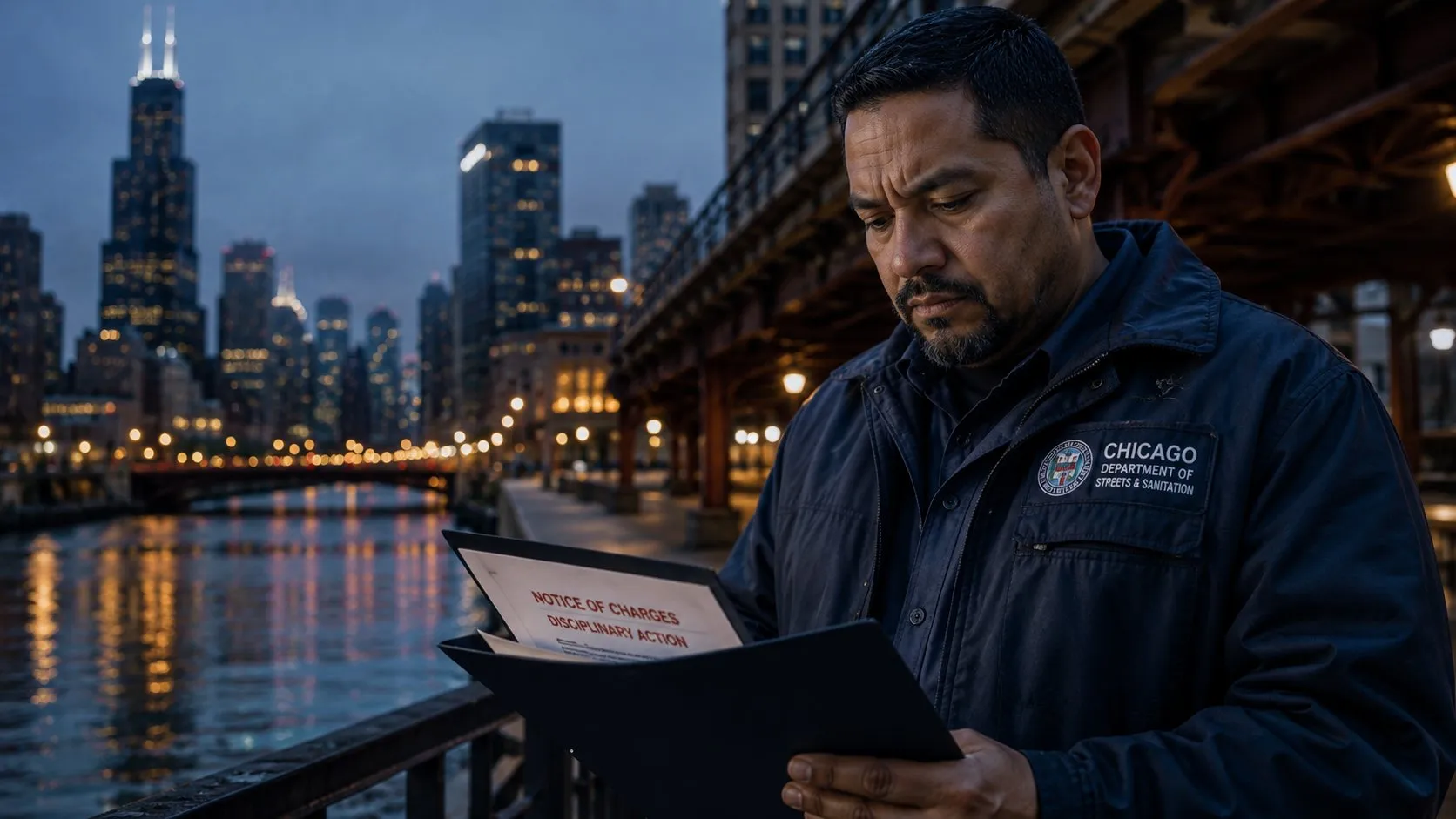
Short answer: Usually not, once you're off probation. Illinois law says a career municipal or fire protection district firefighter can be discharged only for cause, on written charges, after a hearing. Your union contract may send that hearing to an arbitrator instead of the commission. Probationary firefighters have far less protection, and Chicago runs on its own system.
Which rules cover you depends on who employs you, whether you're past probation, and what your contract says.
Who decides whether you get fired?
For most firefighters in Illinois towns, it's the Board of Fire and Police Commissioners. The board is created by Division 2.1 of the Municipal Code in municipalities of 5,000 to 250,000 people and in smaller towns that adopt it.
The core rule is in 65 ILCS 5/10-2.1-17. No officer or member of the fire department "shall be removed or discharged except for cause, upon written charges," and after a hearing before the board. The hearing has to start within 30 days after the charges are filed. The board can suspend you pending that hearing, with or without pay, for up to 30 days.
So the chief can't simply fire you. The board decides. Our article on what happens at a Fire and Police Commission hearing walks through the hearing itself.
What about a suspension from the chief?
Under the same section, the fire chief can suspend a member without pay for up to 5 calendar days, and has to notify the board in writing.
You can appeal that suspension to the board. The deadline is 5 calendar days after the suspension. Miss it and the suspension stands.
On review, the board has four options. It can sustain the chief's suspension, reverse it and order back pay for the days you lost, add up to 30 more days of suspension, or discharge you, "depending upon the facts presented." So an appeal carries real risk. Get advice before you file it, and get it inside the 5 days.
Fire protection district firefighters
If you work for a fire protection district rather than a city or village, the Fire Protection District Act controls. The discipline rules are in 70 ILCS 705/16.13b.
A member "who has held that position for one year" can't be removed or discharged except for just cause, on written charges that name the complainant and the basis, after a hearing before the district's board of fire commissioners. The hearing must start within 30 days of filing. The chief carries the burden of proving the charges by a preponderance of the evidence.
The chief's short-suspension power is about the same: up to 5 consecutive calendar days, with 5 days for you to appeal.
Does your union contract change the answer?
Often, yes.
The Municipal Code lets a municipality and the union negotiate, under § 10-2.1-17, "an alternative or supplemental form of due process based upon impartial arbitration as a term of a collective bargaining agreement." The statute makes that bargaining mandatory unless both sides agree otherwise. The Fire Protection District Act has a parallel carve-out. Where the district and the union have agreed to final and binding arbitration of just-cause disputes, arbitration can take the place of the board hearing.
The Illinois Public Labor Relations Act backs this up. A collective bargaining agreement negotiated under the Act prevails over conflicting statutes and ordinances, subject to listed exceptions (5 ILCS 315/15).
What this means in practice: read your contract's discipline and grievance articles today. Some let you choose between the commission and arbitration. Some require arbitration. Grievance deadlines can run just days, and the union usually decides whether to arbitrate. Call your union rep and put your request in writing.
Probationary firefighters
State law caps the probationary period for a newly appointed firefighter at one year in municipalities under 1,000,000 people (65 ILCS 5/10-2.1-4). When a firefighter has to be a licensed paramedic as a condition of employment, probation can run longer, and during that extension the only reason you can be discharged without a hearing is failing to meet the paramedic licensure requirements.
During ordinary probation, the for-cause and hearing protections generally don't apply. The Illinois Supreme Court has held that § 10-2.1-17 "applies only to an officer who has completed his probationary period," and that a board may adopt rules allowing summary discharge of probationers (Romanik v. Board of Fire & Police Commissioners of East St. Louis, 61 Ill. 2d 422, 425 (1975)). That was a police case, but the same section covers firefighters. The appellate court applies the same rule: unless the board's own rules clearly say otherwise, a board can discharge a probationer without a pretermination notice or hearing (Faustrum v. Board of Fire & Police Commissioners of the Village of Wauconda, 240 Ill. App. 3d 947, 952 (2d Dist. 1993)). Since those decisions, the legislature has added the one-year cap and the paramedic-licensure limit described above, so apply both.
For fire protection districts, the statute says so on its face by protecting only members who have held the position for one year. Check your board's rules, any local ordinance, and your union contract, because any of them can give probationers more protection.
That doesn't mean you have nothing. A probationary firing still can't be based on race, sex, disability, pregnancy, age, or retaliation for protected activity like reporting safety violations or taking FMLA leave. Those claims have their own deadlines.
What about the Chicago Fire Department?
Chicago isn't a Division 2.1 city. It's far over the 250,000 cap.
The state civil service statute for cities, which includes 65 ILCS 5/10-1-18, doesn't govern CFD discipline either. Chicago used its home-rule power to replace those provisions with its own personnel ordinance, as the appellate court held in a case involving a CFD lieutenant's discharge (Resman v. Personnel Board of the City of Chicago, 96 Ill. App. 3d 919 (1st Dist. 1981)).
For firefighters and paramedics represented by Chicago Fire Fighters Union Local 2, the union contract controls. Under its discipline section, § 16.2, members can be disciplined and discharged only for just cause. The same section makes the grievance procedure, up to arbitration, "the sole and exclusive method of reviewing all disciplinary action," and it expressly replaces the City's own appeal procedures. So the Human Resources Board appeal that the Municipal Code provides for other career service employees isn't a second option. That language is in the 2017-2021 contract and in the amended § 16.2 that the City Council approved in October 2025 as part of the 2021-2027 agreement.
You don't pick the forum. A grievance has to be raised within 10 business days, and at the last step the union or the City decides whether to take it to arbitration. The 2025 agreement also added faster procedures for suspensions, which the parties agreed would expire one year after they take effect.
Probationary members, who serve nine months, can't grieve discipline or discharge. If the union asks within 10 days of the discharge notice, the member and the union can present their side at a meeting with the Department, but the Department's decision is final.
The constitutional floor
If you've finished probation and state law says you can be fired only for cause, you have a property interest in your job. The Fourteenth Amendment protects it.
The U.S. Supreme Court held that a public employee with that kind of interest is entitled to notice of the charges, an explanation of the employer's evidence, and a chance to respond before termination. That's the pre-termination hearing described in Cleveland Board of Education v. Loudermill, 470 U.S. 532, 546 (1985). It doesn't have to be a full trial. It does have to happen.
Skipping that step can support a federal claim under 42 U.S.C. § 1983.
Can you get to court after the board rules?
Yes, through the Administrative Review Law, as both §§ 10-2.1-17 and 16.13b provide.
The deadline is strict. You have 35 days after the date a copy of the decision was served on you to file a complaint and have summons issued in circuit court (735 ILCS 5/3-103). Courts treat that deadline as jurisdictional. Late means gone.
The court reviews the record from the hearing. It generally won't take new evidence. Build your record at the hearing.
What to do if you're served with charges or told to resign
Don't sign anything that day. A resignation is usually treated as voluntary, and it can wipe out the hearing you were entitled to. If someone gives you a "resign or be fired" choice, ask for it in writing and ask for time.
Then work through these:
- Get a copy of the written charges and any notice of suspension. Note the date you got them. Deadlines run from there.
- Call your union rep and ask, in writing, that a grievance be filed if your contract allows one.
- Save texts, emails, schedules, run reports, and names of anyone who saw what happened.
- Don't give a statement to investigators without your union rep or a lawyer present.
- Don't post about it. Anything you say publicly can end up in the hearing record.
Sometimes a negotiated outcome makes more sense than a fight. Make that call with full information, not in the chief's office.
If you've been charged, suspended, or told to resign, call GB Law at (312) 248-3303 to talk through your options before your deadlines run.
Attorney Advertising. This article is general information, not legal advice, and does not create an attorney-client relationship. GB Law, 1821 W Hubbard St, Suite 209, Chicago, IL 60622, (312) 248-3303.
Questions people ask
Can my chief fire me on the spot?
Generally no, if you've finished probation. The chief can suspend you for up to 5 calendar days. Discharge requires written charges and a hearing before the commission, or before an arbitrator if your contract provides for one.
How fast do I have to appeal a 5-day suspension?
Within 5 calendar days after the suspension, to the Board of Fire and Police Commissioners or the district's board of fire commissioners. Your contract may also set a grievance deadline.
I'm on probation. Do I get a hearing?
Usually not a commission hearing. You may still have claims if the firing was discriminatory or retaliatory, and paramedic-licensure extensions come with their own limits.
How long do I have to take the board's decision to court?
You have 35 days after the date a copy of the decision was served on you, under the Administrative Review Law. Courts don't forgive late filings.
Speak with an attorney
If any of this sounds like your situation, the first conversation is free and confidential. You will leave knowing the next step.
Call (312) 248-3303This article is attorney advertising and general information only. It is not legal advice, and reading it or contacting GB Law does not create an attorney-client relationship. Deadlines and outcomes depend on the specific facts of each matter. Speak with an attorney promptly so a deadline does not decide your case for you.